
I highly suggest that this Follower Suggestion design be peer-reviewed.
Content recommendation systems have a huge effect on how communities grow and evolve. One thing I like about Mastodon is that user recommendations are done by humans, not machines. This go-slow approach is more resilient to algorithms (even the simple one presented here..)
Here's a recent paper that discusses how recommendation systems can reinforce bias.
https://blog.acolyer.org/2018/05/24/algorithmic-glass-ceiling-in-social-networks-the-effects-of-reco...
So before this gets unleashed on the world please do your research and study the available literature. Get experts to review it and listen to the people that have been doing this for a long time. You can then avoid repeating the mistakes of the past.
I highly suggest that this Follower Suggestion ...
1 min read
When Pong played Humans
3 min read
It was a blistering July day in Las Vegas, with temps hitting 109. Inside the SIGGRAPH 91 convention hall Yello's Rubberbandman looped on the speakers. On each chair: a red/green paddle.
I was a student volunteer, stamping the finest hands in Computer Graphics. Those hands (and my own) each controlled those paddles. Then 5000 people looked up and saw a Pong Game appear on the screen.
And then.. the machine started playing us.
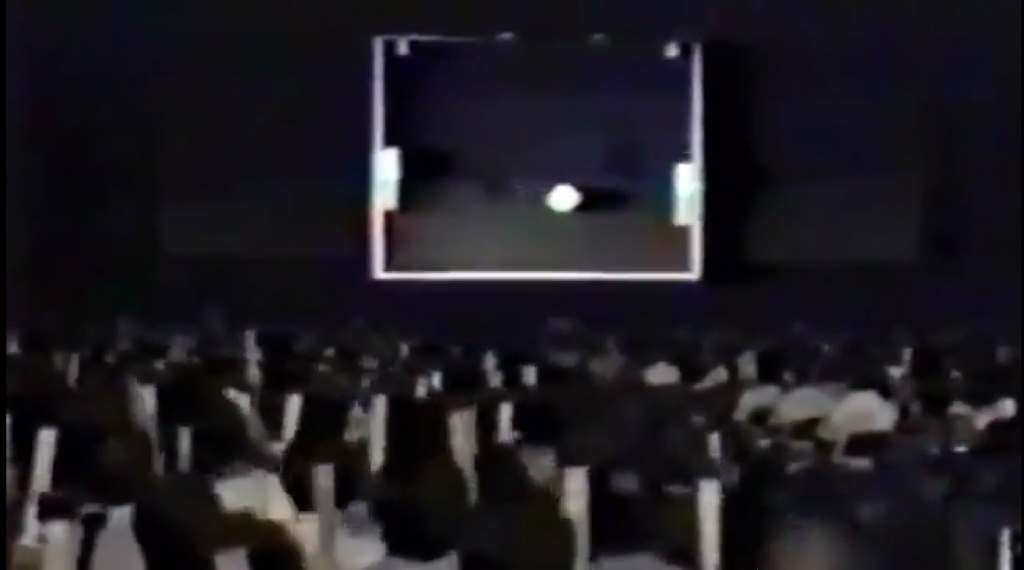
In response to visual stimuli we changed the color of our paddle. The ball moved left, then right. The crowd shouting "red red red", "green!" and cheering as the game played on.
The rules of the game and the feedback loops directed our actions. It was a complex adaptive system with emergent behavior.
And luckily there is some footage of this moment. Watch this excerpt from "Machines of Loving Grace" that talks about this moment in history:
Loren Carpenter Experiment at SIGGRAPH '91 from Zachary Murray on Vimeo.
Loren Carpenter cofounded Pixar. Check out the TurboGopher appearance at the 5:00 minute mark.
Today the simple pong game is now the multilayered technological environment we interact with on a daily basis. Instead of red/green paddles with 1 bit of data we carry phones that generate a wealth more. These devices also provide the aural/visual and haptic stimuli. With that our collective actions power all kinds of "games" today:
- Aggregated location data and movement speed generates traffic data in maps.
- Aggregated search queries and click data deliver better search results.
- Aggregated likes, views and interactions with content power trending data and even news and politics.
As technologists we need to remember that by controlling the game, we are indirectly controlling the players. The choices we allow (and forbid) define the behavior. The game "plays" the player. And often the only way to be free is to not play at all.
Except that is if maybe, just maybe, the people start playing a different game than the one we designed. In the giddy demonstration it was assumed that people wanted to win at Pong. But we didn't play long enough for abuse or scheming. It would have only taken a few people to cross over to sabotage the other side, or for trolls to have changed the outcome.
Finally this level of power and control demands great responsibility. The only thing worse than control used for malicious purposes is control wielded without thought, without thinking of the consequences. So the next time you're designing a product think about the whole system and all the inputs and ask "who's really in control?".
h/t to the General Intellect Unit podcast and their Machines of Loving Grace episode for reminding me of this unsung moment in history.
brb checking my memcached commits on github.
1 min read
brb checking my memcached commits on github.
I also think there's a future for a Branding Agency specializing in vulnerability names. We're no longer content with CVEs any more.
https://blog.cloudflare.com/memcrashed-major-amplification-attacks-from-port-11211/
original: http://www.1500wordmtu.com/2018/brb-checking-my-memcached-commits-on-githubi
brb checking my memcached commits on github. I ...
1 min read
brb checking my memcached commits on github.
I also think there's a future for a Branding Agency specializing in vulnerability names. We're no longer content with CVEs any more.
https://blog.cloudflare.com/memcrashed-major-amplification-attacks-from-port-11211/
@pyg @jibe_jeybee @Chocobozzz @framasoft @resonatecoop please consider ...
1 min read
@pyg @jibe_jeybee @Chocobozzz @framasoft @resonatecoop please consider getting independent content creators involved in the design. I believe that the protocols and software must balance the collective rights and needs of both consumers and creators.
Investing in a better Internet: Resonate, a music coop
4 min read
Do you want a better internet? One that balances the needs of creators and consumers? A more democratic internet? I do. That's why I'm investing in a music coop: Resonate.
Stream to Own
I've been a member-owner of Resonate for a while, and listen every day. It provides an eclectic mix similar to a high quality college radio station. At first glance Resonate is a streaming service like Soundcloud or Spotify. But dig deeper and the you'll find major differences:
- You only pay for what you listen to.
- Each listen debits your balance a small amount.
- On the 9th listen you own the track.
This tiered pricing model incentivizes discovery. Owning actual tracks helps fans develop deeper ties to the music they love.
And I own more than just tracks. My member share means that I own a portion of Resonate, I can vote on how the business is operated and at the end of the year I can share in the profits.
Over the past year Resonate has added more content, more features, and most importably a sustainable organization where fans, musicians, employees and labels can work together towards common goals. This is the kind of “cooperative internet” that I always imagined would emerge back in the pre-web era.
“Purpose above Profits”
"Purpose above Profits" was the slogan at REI as I shopped for the holidays. It’s a reminder that the REI is a Member Cooperative. With my $20 lifetime membership I get dividends based on my purchases while supporting outdoor and environmental causes. In 2016 REI gave back 70% of profits.
This is but one example of how Coops can offer sustainable services for the communities they serve. Growing up I had electric power from an Coop. When I lived in Switzerland there’s a huge retail chain literally named “Coop”. I currently use and support my Credit Union.
Overall Coop businesses are more sustainable, and are oriented to the long term interests of their member-owners.
But the growth of the Internet and the Web bypassed the cooperative model. This despite the fact that open source and much of the shared internet infrastructure are structured like coops. It wasn't until 2014 that the concept of Platform Cooperative was coined. The rise of pseudo-"sharing" platforms like Uber and AirBnB and the rise of decentralized technologies like blockchains were two key reasons that many now embrace the concept.
Early Stage Capital
But a problem emerges, how do you bootstrap a Cooperative where there are significant barriers to entry? That’s where Supporter Shares come in. Anyone can invest in these shares. Each year the co-op sets aside 10% of profits and issues dividends to Supporter Share owners.
But remember that Supporter Shares don't get you extra voting power. A cooperative is still one-person, one-vote. The upside is that there are no leveraged buyouts, no dual share structures or non-voting shares.
The Future Internet
The Internet I want is a democratic one where creators, consumers, supporters and employees can work together towards common, sustainable goals. By using and investing in Resonate I hope to advance those goals. Liz Pelly captured the sentiment in "Protest Platforms" that "Resonate is particularly interesting for the way it advocates for broad decentralization of data, power, and money in music".
The Resonate Project Map details where the project is going and the plan to achieve it. I’ll admit that the content catalog is small, (but growing!) and the technology is very beta (but improving!). I still use and enjoy it every day.
I hope that you'll consider joining the coop as a member owner and see for yourself. If you want to accelerate this type of work consider purchasing Supporter Shares.
And finally, I hope that you'll consider supporting a new generation of online platforms that include the same kind of values that Resonate promotes. All while listening to and supporting the artists we love.
A reminder from Vint Cerf about the importance of digital preservation
1 min read
A reminder from Vint Cerf about the importance of digital preservation
It seems inescapable that our society will need to find its own formula for underwriting the cost of preserving knowledge in media that will have some permanence. - vinton cerf - We're Going Backward
I've seen this firsthand. Albums from some lesser known bands I listened to in the 90s are not available in digital format. When the CDs finally bit rot the music will be gone forever unless someone rips and uploads them. Some content never made the jump from VHS, also at risk of loss when the tapes degrade.
Support the Internet Archive and other efforts if you value this. Also work towards a future self-archiving decentralized web where content can live beyond the data silos they currently occupy.
A reminder from Vint Cerf about the importance of digital preservation
1 min read
It seems inescapable that our society will need to find its own formula for underwriting the cost of preserving knowledge in media that will have some permanence. - Vint Cerf - We're Going Backward
I've seen this firsthand. Albums from some lesser known bands I listened to in the 90s are not available in digital format. When the CDs finally bit rot the music will be gone forever unless someone rips and uploads them. Some content never made the jump from VHS, also at risk of loss when the tapes degrade.
Support the Internet Archive and other efforts if you value this. Also work towards a future self-archiving decentralized web where content can live beyond the data silos they currently occupy.
Didn't realize I was doing "ledgers" way back at the University of Minnesota.
1 min read

Didn't realize I was doing "ledgers" way back at the University of Minnesota. As you can see we weren't that excited writing line-of-business apps. Also funny how Privacy Enhanced Mail never took off. Pity that.
Here's the executive summary for Forms Nirvana from an old design doc:
This document describes an open-architecture forms routing and approval system suitable for routing requests through a multi-person authorization chain. Once a request has been authorized, the completed request can be automagically submitted to another system (for example, the financial system for posting to the general ledger). While WWW is initially envisioned as the vehicle for user interaction with the system, the request routing logic is separated from user presentation so that other technologies (such as E-mail with digital signatures) can be used as well. Provisions are also made for entities other than human signers to be part of the authorization chain, so consistency checks can be automatically applied to the form's content.
Tagged: #throwbackthursday
Original: http://www.1500wordmtu.com/2016/behold-formsnirvana-the-internal-only-logo-from-1996-at-umn