
Sarah Jamie Lewis on Twitter: "In the Dat protocol white paper under Network Privacy, there is a section that reads: "There is an inherent tradeoff in peer to peer systems of source discovery vs. user privacy." I disagree with the statement & the impact resulting design decisions have on privacy. Some notes:"
1 min read
@pyg @jibe_jeybee @Chocobozzz @framasoft @resonatecoop please consider ...
1 min read
@pyg @jibe_jeybee @Chocobozzz @framasoft @resonatecoop please consider getting independent content creators involved in the design. I believe that the protocols and software must balance the collective rights and needs of both consumers and creators.
Code Next Opens in Oakland, creating diversity through Constructionism
1 min read
Code Next Opens in Oakland, creating diversity through Constructionism
"From a design point of view it is a truly unique experience that very much leans on an educational theory known as constructionism. This codified curriculum will soon be available to the entire world as an open source."
Code Next Opens in Oakland, creating diversity through Constructionism
1 min read
"From a design point of view it is a truly unique experience that very much leans on an educational theory known as constructionism. This codified curriculum will soon be available to the entire world as an open source."
I love how this succinctly captures the values I hold dear.
1 min read
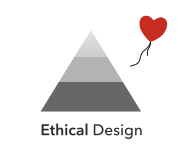
I love how this succinctly captures the values I hold dear. Delightful design based on open principles with recognition of human effort. I have a copy printed out at my desk.
original: http://www.1500wordmtu.com/2016/ethical-design-manifesto
Ethical Design Manifesto
1 min read
I love how this succinctly captures the values I hold dear. Delightful design based on open principles with recognition of human effort. I have a copy printed out at my desk.
Didn't realize I was doing "ledgers" way back at the University of Minnesota.
1 min read

Didn't realize I was doing "ledgers" way back at the University of Minnesota. As you can see we weren't that excited writing line-of-business apps. Also funny how Privacy Enhanced Mail never took off. Pity that.
Here's the executive summary for Forms Nirvana from an old design doc:
This document describes an open-architecture forms routing and approval system suitable for routing requests through a multi-person authorization chain. Once a request has been authorized, the completed request can be automagically submitted to another system (for example, the financial system for posting to the general ledger). While WWW is initially envisioned as the vehicle for user interaction with the system, the request routing logic is separated from user presentation so that other technologies (such as E-mail with digital signatures) can be used as well. Provisions are also made for entities other than human signers to be part of the authorization chain, so consistency checks can be automatically applied to the form's content.
Tagged: #throwbackthursday
Original: http://www.1500wordmtu.com/2016/behold-formsnirvana-the-internal-only-logo-from-1996-at-umn
Behold FormsNirvana. The internal-only logo from 1996 at #umn
1 min read
 #umn" />
Didn't realize I was doing "ledgers" way back at the University of Minnesota. As you can see we weren't that excited writing line-of-business apps. Also funny how Privacy Enhanced Mail never took off. Pity that.
Here's the executive summary for Forms Nirvana from an old design doc:
This document describes an open-architecture forms routing and approval system suitable for routing requests through a multi-person authorization chain. Once a request has been authorized, the completed request can be automagically submitted to another system (for example, the financial system for posting to the general ledger). While WWW is initially envisioned as the vehicle for user interaction with the system, the request routing logic is separated from user presentation so that other technologies (such as E-mail with digital signatures) can be used as well. Provisions are also made for entities other than human signers to be part of the authorization chain, so consistency checks can be automatically applied to the form's content.
You can read more about Forms Nirvana in this Minnpost article.
Tagged: #throwbackthursday
I call mine my "Macbook-C" Seriously awesome hardware.
1 min read
I call mine my "Macbook-C" Seriously awesome hardware.
Originally shared by Google Chrome
Introducing the HP Chromebook 11, designed and built in partnership with our friends at HP. It has all the speed, simplicity and security benefits you've come to expect from a Chromebook, with unique design elements that makes it easier to get stuff done. And all for $279.
Look for it starting today in the US at Best Buy , Amazon.com and Google Play and in the UK at Currys, PC World and more. It will also be coming to other countries in time for the holidays.
Find out more on the Chrome blog: http://goo.gl/tzyHvs